R&D OPERATIONS
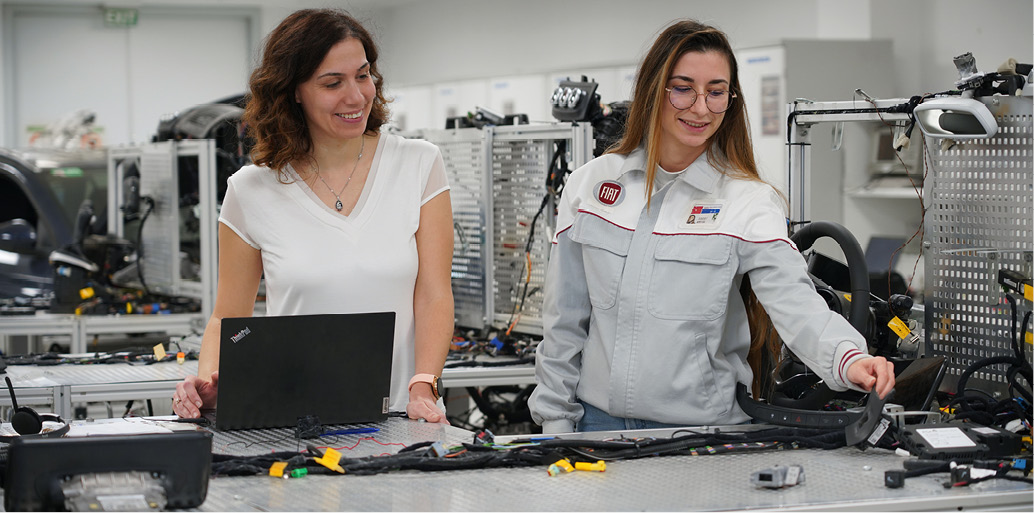
Tofaş R&D Center’s workforce increased by 20% last year. As Tofaş R&D engineering teams gain deeper experience in international projects, their advanced engineering capabilities become integrated into global processes.
A STRONG CONTRIBUTOR TO TÜRKIYE’S R&D AND ENGINEERING ECOSYSTEM
Tofaş enjoys a commanding position among Stellantis Group R&D facilities by virtue of its product-engineering experience, its new-product development competencies, and the diverse capabilities of its high-tech laboratories.
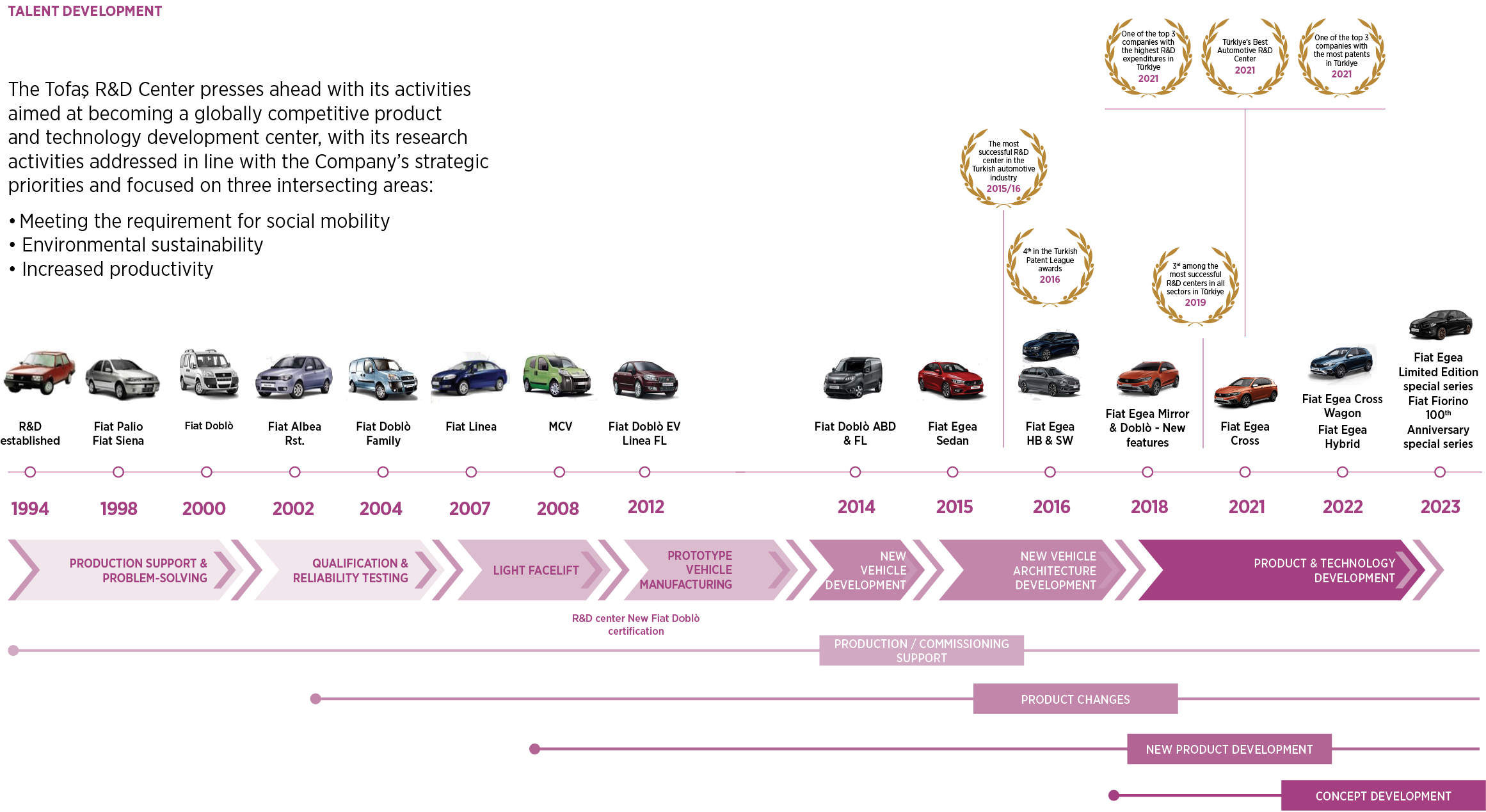
The goal of the Tofaş R&D Center is to be a globally competitive product & technology development leader. The center focuses both on developing and marketing new products that successfully respond to market needs and on improving existing products in line with changes in technology and consumer preferences. While concentrating on continuously improving the design, performance, energy-efficiency, and sustainability of all Tofaş-produced products and services, the Tofaş R&D Center also drives innovation in the automotive industry in such areas as mobility, electrification, connected vehicles, software, and related technologies.
Tofaş regularly spends more on R&D than most other companies in Türkiye. As of end-2023, Tofaş had invested the equivalent of more than EUR 64.4 million on the Tofaş R&D Center’s test laboratory and equipment. The center has become a world-class motor vehicle research and development facility with a total of 20,110 m2 of laboratory and office space.
In 2023 the Tofaş R&D Center worked on adapting Egea and Fiorino engines to meet E6.4 emission standards. Besides making ongoing R&D improvements in existing models, the center also developed vehicles for two special series–Egea Limited Edition and Fiorino 100th Anniversary. In 2023 work began on the industrialization and development phases of four Stellantis Group brands whose vehicles are to be produced under the K0 Project. Additionally, Tofaş R&D was also involved in the development of various Stellantis models.
Tofaş R&D likewise functions as an engineering export center for global product projects. In addition to developing the vehicles that are manufactured by Tofaş in Türkiye, Tofaş engineers also play active roles in the product-development projects of other Stellantis Group brands and models produced throughout the world. By exporting engineering know-how in this way, Tofaş is simultaneously contributing to Türkiye’s economy, industrial expertise, and R&D knowledge base.
Of the more than 900 people on the Tofaş R&D Center’s payroll as of end-2023, 120 held master’s or doctor’s degrees. The center’s workforce increased by 20% last year. As Tofaş R&D engineering teams gain deeper experience in international projects, their advanced engineering capabilities become integrated into global processes across the Stellantis Group. Meanwhile in its efforts to constantly increase the knowledge and skills of Türkiye’s own automotive industry ecosystem so as to expand national potential, the center also employs more than 300 engineers from other countries in the conduct of its operations.
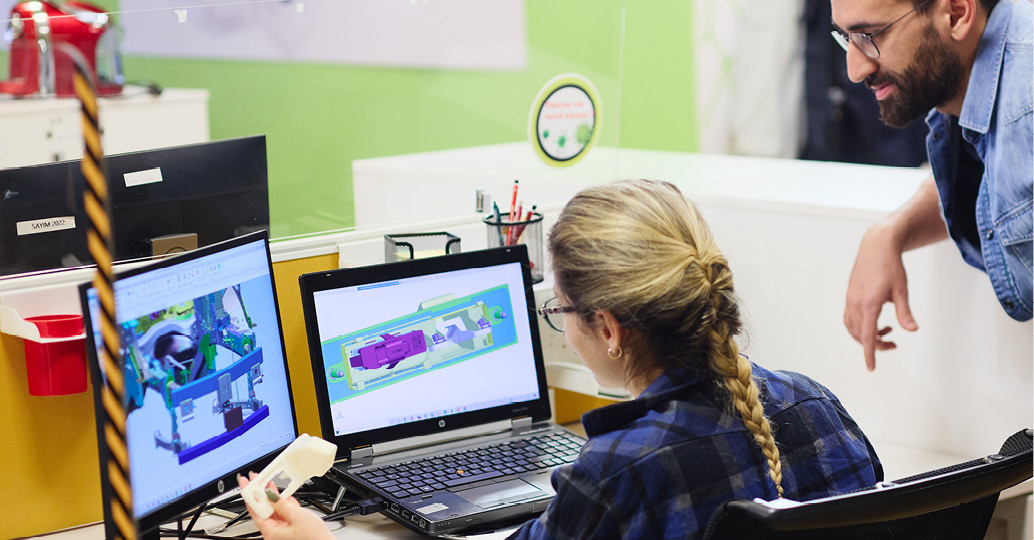
Complementing its engineers’ existing expertise in vehicle design, advanced materials, simulation, and mathematical modelling, the Tofaş R&D Center also focuses on developing their digital skills in order to drive innovation in areas like automotive software and connectivity. As Tofaş assumes increasingly greater responsibilities in Stellantis product development projects and gains strength on a global scale, it will also be making an increasingly greater contribution to the growth and development of Türkiye’s automotive ecosystem.
INNOVATIVE APPROACHES IN PRODUCT DEVELOPMENT COLLABORATIONS
A prerequisite for Türkiye’s increasing its international visibility and viability as a product development center is an ability to simultaneously address all of the elements of the R&D value-creation chain. This is why Tofaş gives special importance to joint design and development projects, to marshaling the resources of local engineering firms, and to working together with universities. Undertaking university-industry collaboration projects in parallel with its technology-development operations, Tofaş R&D collaborated with fifty different universities on more than 200 projects in the last eighteen years.
INTERNATIONALLY-FUNDED EU R&D PROJECTS
When developing products and processes, the Tofaş R&D Center engages with stakeholders in different sectors so as to ensure that the projects on which it is working are conducted effectively and that any social and/or environmental issues which may arise are dealt with. With the benefit of European Union and TÜBİTAK support and the business opportunities created by both platforms, Tofaş develops high added-value, innovative, and sustainable projects.
A leading recipient of research grants under the Horizon 2020, Horizon Europe, and Eureka programs, the Tofaş R&D Center had completed 21 of 32 program-approved projects as of end-2023; an additional 8 new projects approved in 2023 brings the total number of currently active projects to 19. Projects aimed at exploring and developing innovative technologies have so far led to collaborations with over 400 global partners– among them universities, research institutions, and leading automotive-industry concerns. Nine nationally-funded TÜBİTAK projects in the areas of AI-powered manufacturing, advanced materials, electric vehicles, and sustainability are also currently underway. The Tofaş R&D Center has so far submitted a total of 237 patent applications, 33 of which were filed in 2023. These applications are concerned mainly with vehicle components and production systems related to the company’s products and services; 111 of them have been registered to date. Tofaş Horizon Europe projects that were approved in 2023, along with their objectives, are presented below.
- InnoBMS: Develop and demonstrate a future-ready best-in-class BMS hardware & software solution that maximizes battery utilization and performance for the user without negatively affecting battery life, even in extreme conditions, while continuously maintaining safety.
- Heatwise: Develop and validate sustainability-focused technological innovations and solutions related to thermal management in IT systems equipment and complete building management.
- Flash: Develop innovative and environmentally friendly laser-based manufacturing solutions which are more suitable for digital control processes and which generate less waste than traditional mechanical, chemical, and thermal processes.
- Magician and Jarvis: Develop human-robot collaboration technologies that enhance production efficiency and quality.
- ShapeFuture: Determine the requirements for perception sensors and ADAS systems used in autonomous vehicles and develop recommendations for optimization.
- EdgeAI Trust: Develop and virtually validate intelligent ADAS systems that detects driver fatigue and collects information at intersections through a global safety supervisor.
- Froddo: Develop and test methods that utilize advanced perception, machine learning, hybrid artificial intelligence, and simulation to enable better management of dynamic physical and digital infrastructure for connected and autonomous vehicles.
The Tofaş R&D Center has been awarded 237 patents (111 in 2023 alone), mostly for vehicle components and production systems related to Tofaş’s products and services. Last year the center filed applications for another 33 patents and also for two utility models. Tofaş R&D is looking to further increase the number of patents it owns by undertaking projects that seek to explore innovative ideas and benefit from technological innovations.
To date, the Tofaş R&D Center has had ten top- and second-quartile articles published in its name in leading international scientific journals; it has also presented close to 70 papers at national and international conferences.
The Tofaş R&D Center has been awarded 237 patents mostly for vehicle components and production systems related to Tofaş’s products and service.
CONTINUOUS INVESTMENT IN AUTOMOTIVE SOFTWARE
Tofaş is pushing the scope of the responsibilities it undertakes in such areas as designing, virtually & physically verifying, and prototyping components and systems for the Stellantis Group’s portfolio of brands and models to new levels by expanding the operational scope of the Product Development & Automotive Software Branch that its R&D center set up at the İzmir Institute of Technology’s Teknopark İzmir Software Center. Tofaş R&D İzmir works especially on projects in the areas of infotainment system software, powertrain system software calibration, data science & AI-based smart vehicle architecture, autonomous & driverless vehicle solutions, connectivity solutions, automotive cybersecurity, and fleet service management & optimization algorithms.
In 2023, there was an accelerated focus on developing software for power and control systems in internal combustion engines, hybrid vehicles, and electric vehicles. Last year the center’s power system control algorithms team became an element of Stellantis’s software strategic plan when it took on duties within the plan’s sub-component torque & thermal management software groups. For the development of model-based control algorithms, use was made both of traditional and of state-of-the-art methods as dictated by system requirements. The Tofaş R&D team is currently concentrating on algorithm verification and on seamless software-to-code conversion.
In response to evolving hybrid and electric vehicle architectures, Tofaş aims to expand its R&D team so as to increase its knowledge and experience and also begin developing software components for electric power systems.