ENVIRONMENT AND CLIMATE CHANGE1
ENVIRONMENT & ENERGY POLICY
Tofaş regards protecting natural resources and conducting its operations with minimum environmental impact as being among its primary responsibilities. Tofaş focuses on effectively managing and, as much as possible, on minimizing both the direct and the indirect adverse environmental impact of all aspects of its value-creation chain.
Tofaş seeks to pass a clean and livable world on to future generations through a sustainable approach when dealing with environment and energy-related matters. In the conduct of all of its operations, Tofaş complies fully with all national and international requirements and it strives constantly to reduce the environmental impact of its manufacturing activities and of its products and services by making continuous improvements in its performance and through the use of appropriate technologies.
Environmental issues are handled by the Tofaş Sustainability Committee and by the Tofaş Sustainability Working Group in line with Tofaş’s Environmental and Energy Policy. Both committee and working group report directly to the Tofaş Board of Directors concerning the company’s environmental performance.
Tofaş fulfilled its commitment to eliminate single-use plastics and got rid of single-use plastic products originating from individual use throughout the factory.
Tofaş passed all of its official and stakeholder-conducted environmental audits in 2023 with no instances of non-compliance. No environment-related penalties were incurred; no environment-related or similar violations occurred.
As the first automotive manufacturer in Türkiye to be awarded ISO 14001 Environmental Management System certification, which it received in 1998, Tofaş has had a well-established and sustainable environmental management system ever since The company’s zero non-compliance record has remained unbroken every year since its original certification.
- Tofaş deploys effective, integrated environmental management systems in order to:
- Prevent pollution at source and reduce environmental risks;
- Reduce the environmental impact of its products by taking a life-cycle approach;
- Use energy and natural resources responsibly and efficiently;
- Increase the environmental and energy-conservation awareness of employees, other stakeholders, and society at large.
ZERO WASTE MANAGEMENT SYSTEM
Tofaş fulfilled its commitment to eliminate single-use plastics and got rid of single-use plastic products originating from individual use throughout the factory.
Tofaş’s environmental approach is to possess a World-Class Environment Management System that makes use of proactive and efficient management tools. In order to achieve its “Zero Waste/Zero Loss” goal, the company’s maxim is “If you don’t cause pollution in the first place, then there’s nothing that you have to clean up.”
One consequence of Tofaş’s Environment & Energy Policy is that it seeks both to reduce waste at source and to recover and recycle as much as possible of any waste that may be generated. Thus for example 100% of the industrial waste resulting from its manufacturing processes is either recovered or else used as raw material and energy inputs in the cement industry, thereby helping the company to achieve its “Zero Waste Disposal” goal Tofaş’s Zero Waste Management System, which was set up to prevent pollution at source, to use resources responsibly and efficiently and prevent their waste, and to source-separate, collect, and recycle waste, was awarded “Zero-Waste” certification by the Ministry of Environment and Urbanization.
WASTE RECOVERY & REUSE AT TOFAŞ
Insofar as is possible, packaging such as wood, cardboard, plastic sheeting etc associated with materials that Tofaş uses in its production operations is not discarded as waste but recovered and reused both to minimize the environmental impact of such operations and to save on costs. Cardboard for example is put to use in shipments of exported spare parts. Wooden palettes, boards, and slats are used in a variety of ways such as for building planters.
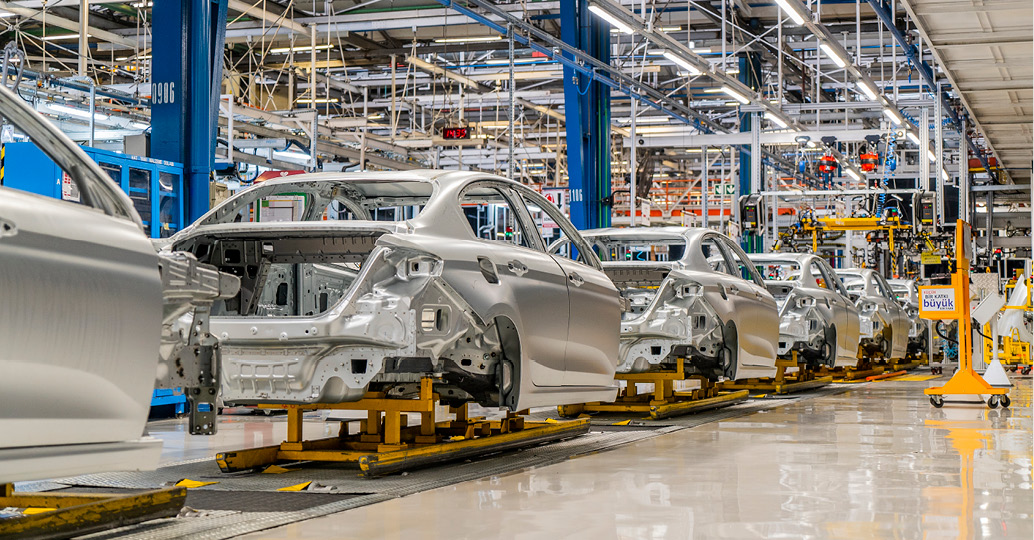
SUSTAINABLE MANUFACTURING ATTITUDES
Having adopted sustainable-manufacturing principles in the conduct of its operations, Tofaş achieves natural resource use efficiency by implementing the “5R” (Refuse, Reduce, Reuse, Recycle, Recover) hierarchy in all of its production processes.
Tofaş’s commitment to sustainable production as evidenced by the findings of a comprehensive Refinitiv review conducted at the Borsa İstanbul stock exchange earned it a place in the BIST 25 Sustainability Index. Tofaş also proactively reports to the Carbon Disclosure Project about the company’s climate change mitigation and water management initiatives.
In order to keep all of its stakeholders informed about its targets on environment and sustainability issues, Tofaş transparently publishes the results of its efforts in these areas in sustainability reports and on its corporate website.
Environmental target |
Performance indicator |
2022 |
2023 |
2024 (T) |
Energy consumption |
kWh/vehicle |
815 |
779 |
753 |
Greenhouse gas emissions |
kg/CO2 (eq)/vehicle |
249 |
199 |
239 |
VOC emissions |
gr/m2 |
28.29 |
27.83 |
40.28 |
Fresh water consumption |
m3/vehicle |
2.74 |
2.61 |
3.75 |
Total waste generated |
kg/vehicle |
26.84 |
25.53 |
33.72 |
% waste disposed in landfill |
% |
0 |
0 |
0 |
ENERGY CONSUMPTION
As a result of efforts to improve its constant-power consumption performance in line with the company’s carbon emissions-reduction targets, Tofaş consumed 779 GJ of energy for each vehicle it produced in 2023. Last year Tofaş also commissioned a number of renewable energy investments, by means of which the company has set itself the goal of reducing its production-operations’ greenhouse gas emissions by 22.6% as of 2026.
Taking into account both the life-cycle aspects of its products and services and the needs and expectations of its stakeholders, Tofaş recognizes that its own production operations and the use of the vehicles that it manufactures make up a significant part of the company’s impact on climate change. Seeking to make it possible for stakeholders to satisfy their mobility, transport, and distribution needs more sustainably, Tofaş seeks to improve the emissions performance of its vehicles while also developing vehicles that make use of non-conventional alternative fuels.
21% of Tofaş’s R&D operations are related to emissions reduction. In support of the transition to a low-carbon economy, Tofaş takes part in projects to increased conventional-engine efficiency, expand the use of alternative fuel systems, and develop electric and hybrid vehicles that are undertaken in line with Stellantis’s product strategies.
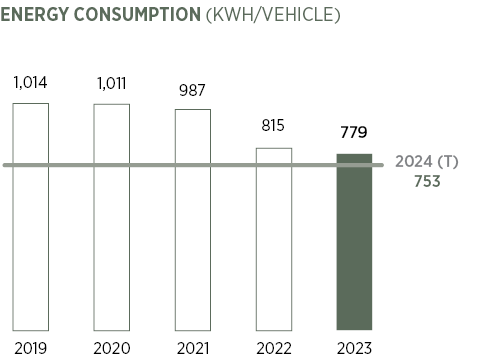
As a result of efforts to decrease fixed-energy consumption in line with its overall goal of reducing carbon emissions, 779 GJ/vehicle energy-consumption performance that Tofaş achieved in 2023 was better than the target that had been set for the year.
|
2019 |
2020 |
2021 |
2022 |
2023 |
Total energy consumption (GJ) |
1,042,245 |
993,438 |
906,678 |
841,801 |
666,508 |
Direct energy consumption - natural gas (GJ) |
593,241 |
578,984 |
519,016 |
463,607 |
355,202 |
Indirect energy consumption (GJ) |
449,004 |
414,454 |
387,662 |
378,194 |
311,306 |
Energy consumption/manufactured vehicle (GJ) |
4.01 |
4.02 |
3.97 |
3.19 |
2.78 |
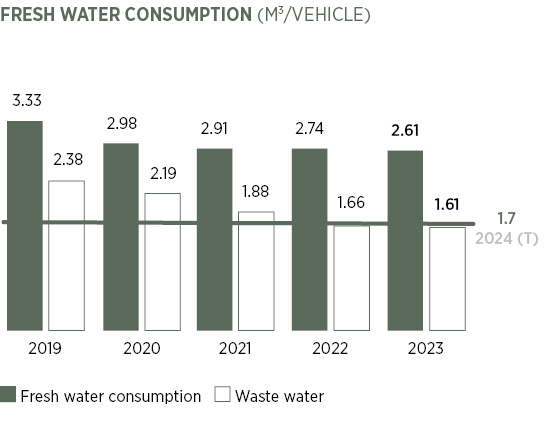
Tofaş makes use of groundwater at its plant. In 2022, an average of 2.74 m3 of fresh water was consumed for every vehicle that was made at the plant; in 2023 this figure was 2.61 m3/vehicle. The company has set itself the goal of further reducing its fresh-water consumption to 1.79 m3/vehicle by 2026 with the assistance of water-recycling projects. A recirculation system installed at the Tofaş plant made it possible for 60 million m3 of water to be reused in 2023. The company also began harvesting rainwater in 2022. The water that is collected is put to use in various ways.
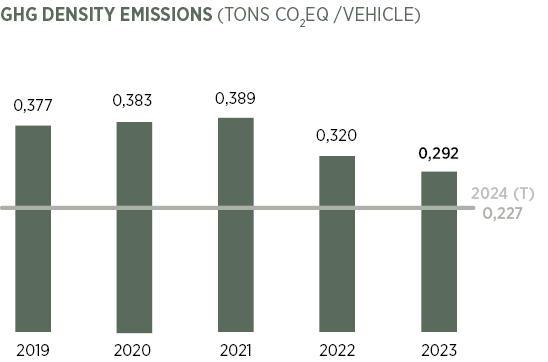
Committed to its vision of ongoing improvement, in 2023 Tofaş launched 259 energy-efficiency projects aimed at reducing the company’s energy consumption and CO2 emissions. Through these projects, a total of 30,637 kWh in energy was saved and a 7,348-ton reduction in CO2 emissions was achieved.
|
2019 |
2020 |
2021 |
2022 |
2023 |
Direct greenhouse gas emissions
(Scope 1) (tCO2e) |
46,266 |
45,653 |
42,790 |
36,621 |
31,500 |
Indirect greenhouse gas emissions
(Scope 2) (tCO2e) |
53,247 |
50,303 |
46,180 |
45,491 |
38,000 |
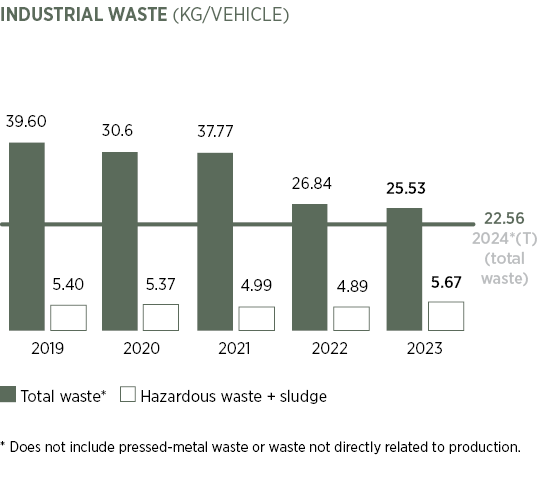
All (100%) of the industrial waste generated in the course of Tofaş’s production operations is recovered and used as raw-material inputs and fuel by cement-makers. This means that Tofaş has effectively achieved its no-disposable-waste (zero-landfill) goal.
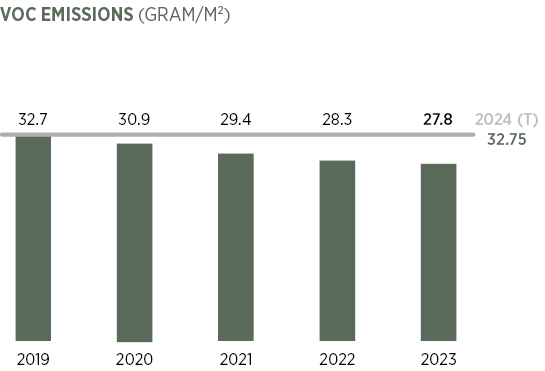
Over the last five years Tofaş has achieved around a 15% reduction in its volatile organic compound (VOC) emissions through improvements in its operational controls.
Along with changes in manufacturing processes such as the use of solvent-free cleaning products, a switch to one-bell spray-painting technology, the introduction of electrostatically-applied water-borne paints, and the commissioning of the company’s nitrotherm spray project, Tofaş has been able to achieve VOC-emission performance ratings that are well below EU-prescribed limits.
Tofaş gives great importance to raising awareness about environmental issues and to promoting environmental awareness among its own employees and those of its business partners.
ECO-FRIENDLY MATERIALS
Tofaş takes a life-cycle approach when considering the environmental impact of its products and services and it manages their negative and positive effects accordingly.
While striving to reduce the environmental impact of the production and use of the vehicles it makes, Tofaş is also constantly engaged in projects to make those vehicles more eco-friendly.
The company sets targets for increasing the use of eco-friendly/recyclable materials in its vehicles while also recovering reusable elements from end-of-life vehicles and ensuring that everything else is disposed of in accordance with national and international regulations. The Tofaş R&D team develops and works with national and international organizations on projects whose aim is to increase the percentages of recyclable and ecofriendly materials used in vehicles.
ENVIRONMENTAL AWARENESS
Tofaş gives great importance to raising awareness about environmental issues and to promoting environmental awareness among its own employees and those of its business partners. Environmental management is also part of Tofaş’s annual target deployment and performance evaluation system.
Efforts are made to control and improve Tofaş’s environmental impact whether it arises directly from its own operations or indirectly anywhere along its value chain. The company has committed itself to the constant reduction of any adverse environmental impact.
Tofaş gives great importance to creating awareness about environmental issues and to promoting environmental awareness among its own employees and those of its business partners.
- As part of its efforts to increase environmental awareness, 3,048 employees were provided with a total of 1,721 hours of training in the form of Tofaş Academy training modules as well as through digital platforms during 2023.
- Energy-conservation and environment-protection projects and competitions are used along with visual and other materials to increase environmental awareness within the factory.
- Tofaş employees and their families take part in company-organized observances of World Environment Day on June 5th every year. During the 2023 events, children fashioned birdhouses and cat shelters from discarded wooden pallets. These were subsequently installed in suitable locations on the factory grounds.
ZERO NON-COMPLIANCE
Tofaş commissioned its ISO 14064-1 Greenhouse Gases Management System in 2020 and has been having its annual GHG emissions reports verified ever since. The company’s ISO 50001 Energy Management System was also commissioned in 2013. Independently-conducted audits performed in 2023 found no instances of standards noncompliance in either system. At the time this report was in preparation, no Tofaş operations or other activities had been included in any carbon pricing system, no carbon credits had been purchased, and no carbon-pricing mechanisms were being implemented within the company.
SUPPORTING THE LOW-CARBON ECONOMY TRANSITION
Tofaş regards climate change as a matter that has legal implications (such as emission limits), physical and operational implications (such as radical changes in weather conditions), and financial implications (such as emissions trading). As part of its general corporate risk-management operations, the company identifies what risks these issues may entail, determines what its responses will be, and develops sustainable and effective solutions to deal with them.
Tofaş keeps a close watch on the progress of the European Green Deal in order to integrate EGD policies and practices into its own strategies for combating climate change. Tofaş is currently engaged in efforts to make itself a net-zero company. The conduct of its projects to reduce emissions arising from production operations and the results that those projects achieve are independently verified and certified every year.
Supporting the transition to a low-carbon economy through its energy-efficiency efforts, Tofaş is also a corporate member of the Climate Platform. Tofaş has also committed itself to the “2 ˚C Challenge” program, an internationally-promoted corporate-mission statement that calls for global policies and actions to tackle climate change. In January 2023 Tofaş also joined the Science Based Targets initiative. The hundreds of energy efficiency projects which the company has undertaken are steadily reducing the energy density of its operations. When new investments are to be undertaken or changes are to be made in machinery and equipment, environmental-impact and energy-efficiency procedures are standardized both by initiating a Kanban (lean/just-in-time manufacturing) process and by adhering to best-available-technology (BAT) practices.
Tofaş works with NGOs, professional associations, and statutory authorities in the formulation of policies to deal with environmental issues. As a member of the Turkish Automotive Manufacturers Association and of the Turkish Industry and Business Association, it takes part in both organizations’ working groups. Tofaş likewise seeks to contribute to the environmental value chain through partnerships with universities and with professional associations and chambers.
Seeking to directly understand its customers’ quality expectations, Tofaş strives to raise the quality of its manufacturing and service processes and to maximize its quality competitiveness throughout its value-creation chain. The company’s quality management system is regularly updated and improved in light of changes in customers’ expectations.
In line with its customer satisfaction-centric sustainable quality approach, Tofaş strives to improve its quality indicators consistently every year. As a result of its efforts in this direction, Tofaş received the fourth highest score in the 2023 round of the Stellantis Group’s annual assessment of its factories’ performance on the sustainable-quality front.
1 Published as a section of Tofaş’s 2023 annual report, this environmental performance report covers all environment-related activities carried out by Tofaş Türk Otomobil Fabrikası A.Ş. during the period beginning on 1 January 2023 and ending on 31 December 2023. Unless otherwise noted, this report does not cover the environmental performance either of Tofaş’s Fer Mas Oto Ticaret A.Ş. or Koç Fiat Kredi Finansman A.Ş. subsidiaries or of dealerships. For the same reason, 2023 data had not yet been independently verified at the time this report was still in preparation. All prior-year data has been verified however.