OCCUPATIONAL HEALTH & SAFETY
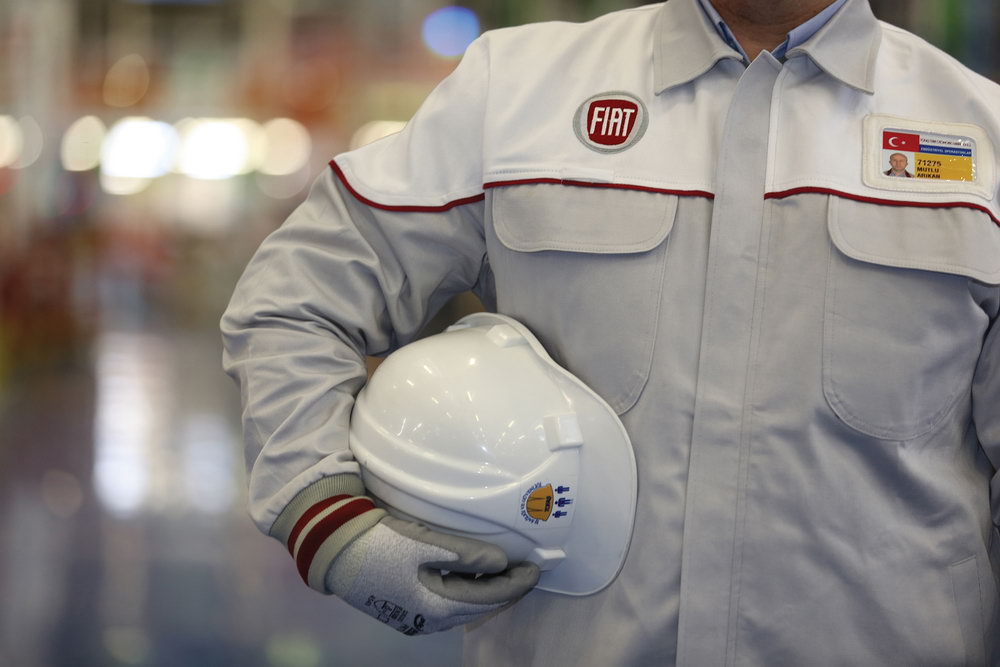
ADHERING TO A PROACTIVE AND LEAN WCM-BASED APPROACH TO OCCUPATIONAL HEALTH AND SAFETY ISSUES, TOFAŞ SEEKS TO CREATE ENVIRONMENTS THAT ARE INTRINSICALLY SAFE.
Occupational health and safety (OHS) ranks the first among the elements of World Class Manufacturing methodology, since it is the most important one. It is also an area in many aspects of which the Tofaş plant serves as a reference model within the FCA community. The plant is frequently visited by firms wishing to observe Tofaş’s OHS operations and practices in action.
Adhering to a proactive and lean WCM-based approach to occupational health and safety issues, Tofaş seeks to protect everyone coming into contact with its operations from risks that could be detrimental to their health or safety by fostering a sustainable OHS culture and by creating environments that are intrinsically safe.
In the 2018 edition of “Good Practices Awards” handed out by the European Agency for Safety and Health at Work, Tofaş placed first among the contenders from Turkey, thereby acquiring the right to represent its country in the upcoming second round that will encompass all of Europe.
AN ADVANCED OHS CULTURE
Tofaş strives to maximize OHS awareness not just among its own employees but also among its trainees, visitors, suppliers, and contractors. To this end, Tofaş commits itself to:
- Fulfilling all of its regulatory and other obligations with respect to OHS issues;
- Abiding by the principle that making improvements in OHS performance is a responsibility shared by all personnel;
- Setting targets for participation in risk-assessment and risk-mitigation activities at every level;
- Achieving a sustainable “Zero Accident” target by constantly improving the company’s occupational health and safety culture.
TARGET: ZERO ACCIDENTS AND OCCUPATIONAL DISEASES
Tofaş seeks to achieve zero-level values of accidents and occupational diseases by means of the Occupational Health & Safety System that it implements. Since the introduction of the World Class Occupational Safety program, the company’s Lost Time Accident rate has been reduced by 95%.
During 2018, 6,920 Tofaş employees were given a total of 87,978 hours of training on OHS issues. Some aspects of Tofaş’s OHS activities last year are highlighted below.
- Safety Simulation Area Training: Safety Simulation Area (DOJO) training is conducted so as to train personnel on safety-related issues and risks by allowing employees to work with real and simulated equipment and tools in carefully controlled environments. DOJO training is highly effective in manufacturing operations such as body-in-white, assembly, painting, stamping, and chassis suspension. A total of 21,124 hours of DOJO training was provided to employees in 2018.
VR-Based Safety Audit Certification: Virtual reality (VR) technology is employed to certify and measure workers’ abilities to identify risks in practice and to bring all personnel to the same level. Under this program, three-dimensional videos of a production area containing various safety violations are shown and employees are asked to identify the risks. Points are given for each instance that is spotted and those who get a sufficient number of points qualify as safety auditors.
- Contractor Management Procedures: Sets of instructions and associated forms have been created and are used to proactively manage contractors’ operations by ensuring, through audits and inspections, that all rules are communicated and understood before work begins and that such rules are abided by during the conduct of operations.
- Safety Dramatization Training: Interactive play-acting is used as a training methodology both to strengthen OHS culture in general and to draw attention to the consequences of unsafe behavior in non-routine tasks. This training provides employees with a gamified experience that helps them to learn about workplace safety.
- Attention & Perception Testing: Referred also to as the “Vienna Test”, Attention & Perception Testing is a method especially useful for determining attention, perception, concentration, and motor-skill levels among machinery and equipment operators, maintenance personnel, quality control personnel, and vehicle drivers.
- Safety Captain: This is a safety program in which one line worker is designated the safety captain of a team of eight to fifteen people and given responsibility for safety for a week. Captains are identified by a special cap and armband, they continue to perform their regular jobs while also keeping on the lookout for unsafe conditions and violations of safety rules.
- Workplace Safety Drawing Contest: The goal of this program is to support workplace safety culture by reaching out to employees’ children through a Workplace Safety Drawing Contest that is held every year. Children taking part in the contest and their families are invited to visit the plant and attend a ceremony during which prizes are handed out. The drawing are displayed in various locations around the plant.
- Safety Pennants: Safety pennants are used to indicate the status of production teams. Blue pennants are hung to indicate that no accidents have occurred there; orange ones signal that one has.